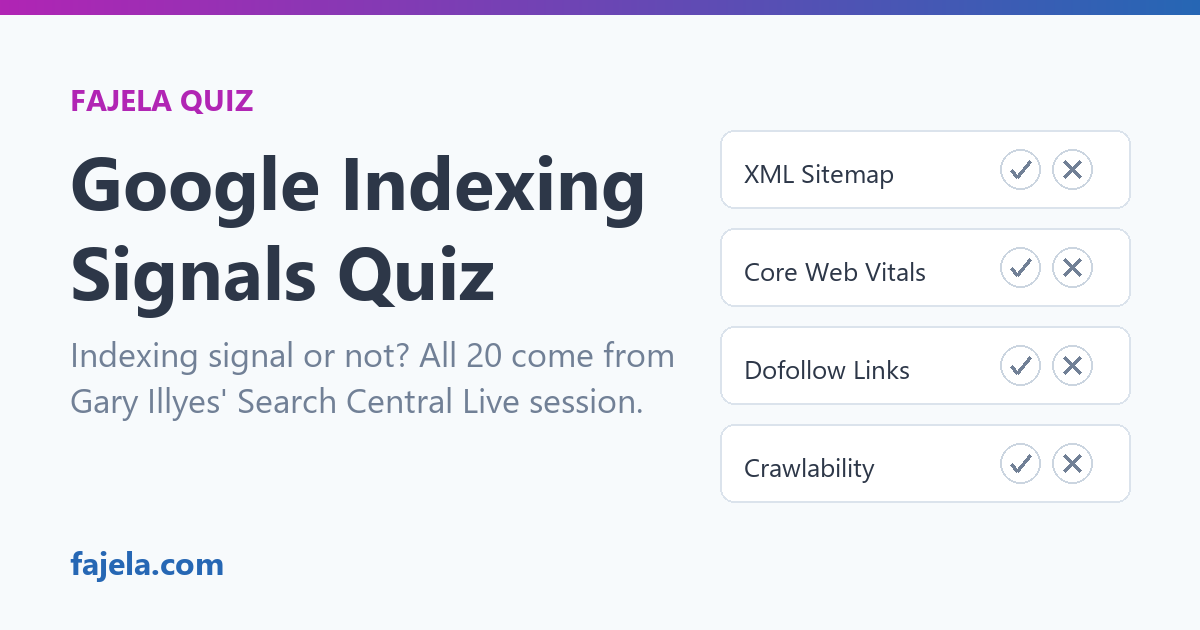
Google Indexing Signals Quiz from Search Central Live
Google indexing signals decide whether a crawled page earns a place in the search index, and they are not the same thing as ranking factors or discovery signals. The quiz below gives you 20 well-known SEO signals; your job is to mark which of them work at the indexing stage, rather than discovery or ranking. Gary Illyes ran the original version at Search Central Live, so the answer key comes straight from Google. When we played it live at an SEO meetup, nobody finished without a mistake.
Indexing Signal or Not
Pick an answer for every signal, then check your score. ✓ means it affects indexing, ✗ means it does not.
The interactive mode needs JavaScript. The 20 signals are listed below; decide for each one whether it influences indexing.
How Google Processes a Page
Indexing is the stage where Google stores a page in its search index. Before a URL earns that spot, it moves through a pipeline, and every step has its own criteria:
- Discovery: Google learns the URL exists
- Crawling: Googlebot fetches the page
- Indexing: the page is processed and stored in the index
- Serving: the stored page becomes eligible to appear in search results
The stages do not guarantee each other. Finding a URL does not mean Google will crawl it. A crawled page will not necessarily be indexed. An indexed page will not necessarily show up in search results. And showing up is still not a top position. Rendering happens inside that indexing stage too: Google indexes the rendered HTML produced after JavaScript runs, which is exactly what Martin Splitt’s talk on debugging JavaScript websites gets into.
20 Indexing Signals
The quiz mixes signals for indexing with ones from every other stage of the pipeline, which is exactly what makes it tricky. The list spans:
- technical setup, from HTTPS to sitemaps and Core Web Vitals
- links, both external ones and internal linking structure
- content quality, including depth, freshness, and search intent
- site-level trust, such as domain history, E-E-A-T, and spam policies
- international targeting with country, language, and hreflang
Every signal on the list genuinely matters for SEO somewhere. The question is never whether it is important, only whether index selection is the stage where it does its work.
Why Indexing Gets Confused with Ranking
Indexing criteria trip up even experienced SEOs. Discovery gets mixed up with index inclusion, and inclusion gets mixed up with positions. These are separate systems with separate inputs: a signal can be critical for rankings yet irrelevant to whether the page enters the index, and the other way around. Google’s own Search Relations advocates, John Mueller and Martin Splitt, spend much of their time redrawing this exact line for the SEO community. That is why a low score here says nothing about your expertise. At our meetup the best result still had one error, so do not treat the quiz as a measure of how good an SEO you are.
Where the Quiz Comes From
The indexing quiz was created by Gary Illyes and presented at one of the Search Central Live events, where Cherry Sireetorn Prommawin confirmed the answer key.